- Key Takeaways
- Introduction
- What a Pre-Action Protocol Letter Is
- When a PAP Letter Is the Right Step, and When It Is Not
- How the PAP Process Works with the Home Office
- The PAP Does Not Stop the Judicial Review Clock
- Where the Claim Goes: Upper Tribunal or Administrative Court
- What Changed in the Upper Tribunal on 6 November 2026
- Delay Cases and Costs: What Nisar Decided
- Administrative Review, Appeal, Judicial Review or a Fresh Application: Comparing the Routes
- Mistakes That Cost Claims at the Pre-Action Stage
- How Can WPC Lawyers Help?
- Conclusion
- Glossary
- Frequently Asked Questions
Key Takeaways
- A pre-action protocol letter is the step before judicial review, not a replacement for an appeal. Judicial review should only be used where there is no adequate alternative remedy (paragraph 5 of the Pre-Action Protocol for Judicial Review), so if your refusal letter gives a right of appeal or administrative review, use it first: 14 days from inside the UK, 28 days from outside, and 7 days for an administrative review if you were detained.
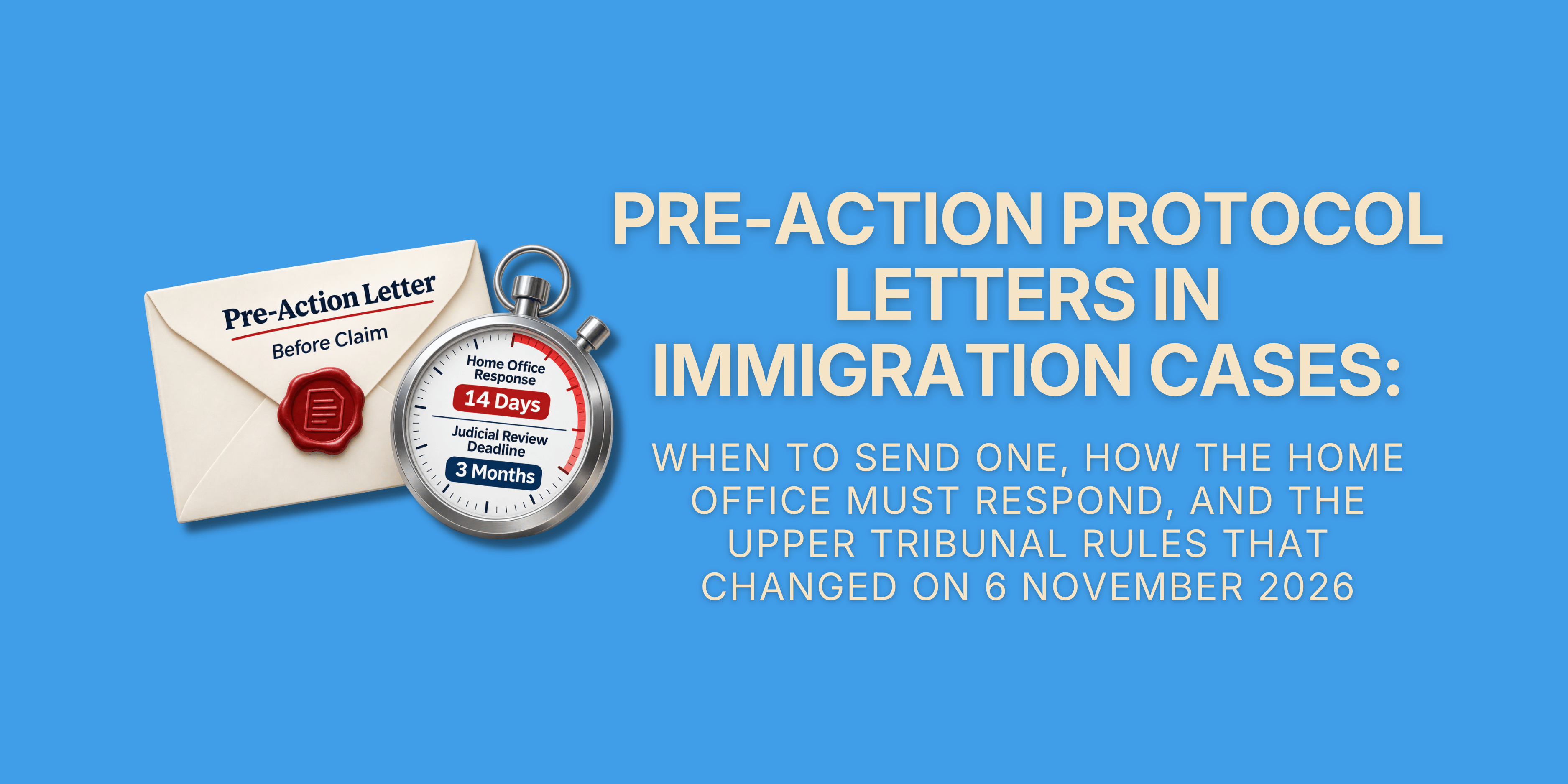
- The letter does not stop the judicial review clock. Under rule 28(2) of the Tribunal Procedure (Upper Tribunal) Rules 2008, your application must be made promptly and reach the Upper Tribunal no later than 3 months after the decision, action or omission you challenge, and neither the Protocol, an interim reply nor a promise to reconsider extends that.
- The Home Office should normally reply within 14 days. The Protocol treats 14 days as reasonable in most cases (paragraph 20 and Annex A). Use the Home Office template and send it to UKVIPAP@homeoffice.gov.uk. An interim reply asking for more time does not extend the time limit, and you need not accept an unreasonable extension (paragraph 21).
- An offer to reconsider withdraws the decision, it does not grant the visa. In both appeals decided in Nisar, the Home Office agreed to reconsider and then refused again, and a fresh refusal is a new decision that needs its own challenge.
- When the Home Office misses its own decision date, its exact wording decides whether you must write again. In R (Nisar & Ors) v SSHD [2025] EWCA Civ 1646 (16 December 2025), a promise that a decision "will be made by" a date was a legal obligation, so issuing the day after it passed was reasonable and the Home Office had to pay costs; where it only "aims to" decide, send a fresh pre-action letter about the delay first, or risk no order for costs.
- Since 6 November 2026, the Upper Tribunal seals your claim and you serve it within 9 days. Rule 28A(1A) and the amended rule 28A(2), inserted by SI 2026/1084, run the 9 days from the date the Tribunal sends you the sealed application, not from the date you applied.
- You can now reply to the Home Office's acknowledgment of service, but only within 7 days. New rule 29A requires the reply to reach the Tribunal within 7 days after the acknowledgment is sent or provided to you, with copies to the other parties within 7 days after that, and the parties cannot extend these limits by agreement.
- A final decision can now be given in writing, which changes how you appeal it. SI 2026/1084 omitted rule 40(1A) and (1B), and new rule 44(4BA) gives you 12 working days from the date the Tribunal sends notice of a written decision to apply for permission to appeal.
- Nobody has yet confirmed how the new rules apply to claims lodged before 6 November 2026. SI 2026/1084 contains no transitional provision and its Explanatory Memorandum is silent, so the cautious course is to meet the new deadlines for any step falling on or after that date and to ask the Tribunal for directions where it matters.
- Most immigration judicial reviews go to the Upper Tribunal, but some stay in the Administrative Court. Under the Lord Chief Justice's transfer direction, challenges to detention, sponsor licence decisions, British citizenship, asylum support and the validity of the Immigration Rules remain in the High Court, where CPR Part 54 applies.
- WPC Lawyers prepares pre-action protocol letters and brings judicial review claims against the Home Office. See our Challenging UK Visa Refusals service and the fixed fees for both stages on our fees page.
Introduction
If the Home Office has refused your application and the decision letter says there is no right of appeal, or if it has simply stopped answering, the next step is usually a letter before claim under the Pre-Action Protocol for Judicial Review. The letter tells the Home Office what is wrong with its decision, what you want it to do, and that you will apply for judicial review if it does not put things right. A well-aimed letter sometimes ends the dispute without a court. A letter sent to the wrong decision, or relied on while the deadline runs out, can cost you the claim or the right to recover your costs.
This guide settles five questions. When a pre-action protocol letter is the right tool, and when an appeal or administrative review has to come first. What the Home Office must do once it receives the letter, including what an offer to reconsider means. How the 3-month time limit runs while you wait. Where the claim goes if the letter fails. And what changed in the Upper Tribunal on 6 November 2026, when the Tribunal Procedure (Upper Tribunal) (Amendment) Rules 2026 came into force.
Everything here is law in force on 25 November 2026: the Pre-Action Protocol for Judicial Review, the Tribunal Procedure (Upper Tribunal) Rules 2008 as amended by SI 2026/1084, Part 54 of the Civil Procedure Rules and the Court of Appeal's judgment in Nisar. One point is genuinely open, which is how the new Upper Tribunal rules apply to claims lodged before 6 November 2026. We say so where it arises, and we keep what the statutory instrument itself says separate from what has been said about it since.
Two things are deliberately left to other posts. If you face removal in the next few days, the Protocol is not the right route and you need our guide to urgent judicial review. If your administrative review is still pending, read our guide to administrative review, 3C leave and immigration bail first.
What a Pre-Action Protocol Letter Is
The Pre-Action Protocol for Judicial Review, published by the Ministry of Justice with the Civil Procedure Rules, is a code of good practice setting out the steps parties should generally follow before a claim for judicial review (paragraph 2). Judicial review is the procedure in which a judge decides whether a public body acted lawfully. It does not decide whether the decision was right on its merits. The pre-action protocol letter, also called a letter before claim or a PAP letter, is the claimant's first step under the Protocol. Its purpose is to identify the issues in dispute and see whether litigation can be avoided or narrowed (paragraph 14).
The Protocol is not optional in practice. Where it is appropriate, the court expects you to comply with it before issuing (paragraph 7), and it takes compliance into account when it gives directions and makes costs orders. Paragraph 8 applies the same expectation in the Upper Tribunal (Immigration and Asylum Chamber), which hears most immigration judicial reviews.
Two limits are built into the Protocol itself. It is not designed for very urgent cases, such as imminent removal, where the claim should be issued immediately (paragraph 6). And a letter before claim does not stop the decision being carried out, although the Home Office may agree to take no action until it replies.
When a PAP Letter Is the Right Step, and When It Is Not
Judicial review is the last resort
If the law gives you a right of appeal or a right to administrative review, use that first. Paragraph 5 of the Protocol says judicial review should only be used where no adequate alternative remedy is available. A judicial review claim against a decision you could have appealed, or had reviewed, is likely to be refused permission for that reason alone.
Your decision letter tells you which remedy you have. A refusal of a protection or human rights claim, a revocation of protection status, and most EU Settlement Scheme decisions carry a right of appeal to the First-tier Tribunal (Immigration and Asylum Chamber). Under rule 19 of the First-tier Tribunal Rules 2014, the notice of appeal must arrive within 14 days of the decision being sent if you are in the UK, or 28 days if you are outside it. Most other refusals carry a right to administrative review: 14 days from inside the UK, 7 days if you were detained on the day of the decision, and 28 days from outside the UK.
The decisions a PAP letter is used for
A pre-action protocol letter belongs to the cases where those routes are not available, or have already been used. In practice that means four groups.
| Situation | Why judicial review is the route | What to watch |
|---|---|---|
| A decision with no right of appeal and no administrative review | Nothing else can test whether the decision was lawful. Most visitor visa refusals, and refusals to treat further submissions as a fresh claim, fall here. Our sister firm WorkPermitCloud sets out the options after a visitor visa refusal. | Judicial review tests lawfulness, not the merits. If the problem is missing evidence, a fresh application may be quicker. |
| A decision maintained after administrative review | The review was the alternative remedy. Once it has failed, judicial review is the remaining way to challenge the decision as maintained. | Do not assume the 3-month clock started late. If there is any doubt which date starts it, work from the earlier one. |
| Unreasonable delay | There is no decision to appeal. The claim challenges the failure to decide, and the remedy is usually an order that the Home Office decide within a set time. The transfer direction treats an omission or failure to decide as a decision (paragraph 4). | Raise the delay in a pre-action letter before issuing. A firm decision date already promised by the Home Office can change that, as the Nisar section below explains. |
| An unlawful certificate | Some certificates, such as a certificate that a claim is clearly unfounded, remove or restrict an appeal. The certificate itself can only be challenged by judicial review. | Certification is often linked to removal. If removal is close, the urgent procedure applies instead. |
When the Home Office cannot change the decision
The letter is written to the body that can put the decision right. Where the decision you challenge belongs to a tribunal, for example a First-tier Tribunal decision from which no appeal lies, the Home Office cannot change it, and the Immigration Advice Authority's practice note on judicial review case management says the Protocol is not appropriate in that situation. Rule 28(3) of the Upper Tribunal Rules gives a separate time limit for those claims: 1 month after the First-tier Tribunal sent written reasons, or notice that a set-aside application failed.
How the PAP Process Works with the Home Office
Use the Home Office template
The Home Office publishes its own form, Resolve a dispute with the Home Office through the pre-action protocol, and paragraph 15 of the Protocol points immigration, asylum and nationality claimants to it. The form was first published on 13 April 2015 and last replaced on 16 April 2025, to reflect the new name of the Immigration Advice Authority. It follows Annex A of the Protocol: the decision challenged and its date, the Home Office reference, a clear summary of the facts, why the decision is unlawful, the remedy you want, any proposal for resolving the dispute without court, the documents and information you need, any interested party, and the date by which you expect a reply.
Shorter is usually better. The Immigration Advice Authority's practice note says pre-action letters should be reasonably brief and to the point, with legal authority and Home Office policy limited to the key text and applied closely to the facts. A letter that buries the one good point under ten weak ones gives the Home Office an easy reason to maintain the decision.
Where to send it
The Home Office template says the letter should be sent electronically to UKVIPAP@homeoffice.gov.uk, with a postal address in the form as the alternative. Include every Home Office reference you have. If you have none, Annex A asks for your full name, nationality and date of birth. The template page says it must not be used in urgent cases, such as where someone is about to be removed from the UK.
The 14-day response and interim replies
The Home Office should normally reply within 14 days, using the Annex B format (paragraph 20). Annex A describes 14 days as a reasonable time to allow in most circumstances. Paragraph 18 adds that a claim should not normally be issued until the proposed reply date has passed, unless the case is urgent, and that the letter should be sent early enough for a reply to arrive before the time limit expires.
If the Home Office cannot reply in full within the period, it should send an interim reply proposing a reasonable extension, with reasons and a date for a full response (paragraph 21). That interim reply does not extend the time limit for your claim, and you are not obliged to accept an extension that is unreasonable. This is where claims are most often lost: waiting politely for a substantive reply while the 3-month period runs out.
What the reply can say
| Home Office reply | What it means | Your next step |
|---|---|---|
| Concedes in full | The Home Office accepts the decision was wrong. Paragraph 22 requires it to say so in clear and unambiguous terms. | Check that what is offered matches the remedy you asked for, and when it will happen. |
| Agrees to reconsider | The decision is withdrawn and a new one will be made. That new decision may be another refusal. | Note the exact words of any timescale. "Will be made by" and "aims to" have different consequences, as Nisar shows. |
| Maintains the decision | The Home Office disputes your grounds, and paragraph 23 expects it to explain why. | Decide whether to issue, promptly and within the 3-month limit. |
| Interim reply asking for more time | A full answer is promised later. | Diarise your deadline. The interim reply does not move it. |
| No reply by your proposed date | The Home Office has not complied with paragraph 20. | You may issue. The court can take the failure into account on costs. |
An offer to reconsider is not a grant
The commonest Home Office response in visa refusal cases is an agreement to withdraw the decision and look at the application again. That avoids a claim, but it promises nothing about the result. In Nisar, the Home Office agreed to reconsider after each of several pre-action letters, and each reconsideration ended in another refusal. In the companion appeal, Mammedov, the reconsidered decision was also a refusal. A fresh refusal is a new decision. Challenging it generally means a new pre-action letter, addressed to its reasons, with its own time limit running from its own date.
The PAP Does Not Stop the Judicial Review Clock
Sending a pre-action protocol letter does not pause or extend the time limit for judicial review. The Protocol says so at paragraph 1, and paragraph 9 makes the same point about attempts to settle the dispute.
In the Upper Tribunal, rule 28(2) of the Tribunal Procedure (Upper Tribunal) Rules 2008 says the application must be made promptly and, unless another enactment sets a shorter limit, must be received no later than 3 months after the date of the decision, action or omission to which it relates. In the Administrative Court, CPR rule 54.5 requires the claim form to be filed promptly and in any event not later than 3 months after the grounds to make the claim first arose. The wording differs, but the effect is the same in most refusal cases: the 3 months is a backstop, and a claim filed inside it can still be refused as not prompt.
Neither forum allows the parties to agree more time between themselves. CPR 54.5(2) says so expressly. Under rule 28(7) of the Upper Tribunal Rules, a late application must include a request for an extension and the reason for the delay, and the Tribunal must not admit it unless it extends time under rule 5(3)(a). Footnote 1 to the Protocol says compliance with the Protocol may be relevant to an extension but is not enough on its own.
The same structure applies at every later stage, and since 6 November 2026 the Upper Tribunal procedure is closer to the Administrative Court's than it was.
| Step | Upper Tribunal (IAC) | Administrative Court (CPR Part 54) |
|---|---|---|
| Time limit | Promptly, and received no later than 3 months after the decision, action or omission (rule 28(2)) | Promptly, and in any event not later than 3 months after the grounds first arose (rule 54.5(1)) |
| Extending time | Only the Tribunal can extend; a late application must ask and explain why (rule 28(7)) | Not by agreement between the parties (rule 54.5(2)); only the court |
| Sealing and service | Since 6 November 2026, the Tribunal seals the accepted application and the applicant serves it within 9 days after the Tribunal sends it (rule 28A) | The claimant serves the claim form within 7 days after the date of issue (rule 54.7) |
| Acknowledgment of service | Within 21 days after the applicant provides the application (rule 29(1)) | Within 21 days after service of the claim form (rule 54.8) |
| Reply to acknowledgment | Since 6 November 2026, within 7 days after the acknowledgment is sent or provided; not extendable by agreement (rule 29A) | Within 7 days after service of the acknowledgment; not extendable by agreement (rule 54.8A) |
| Content and length of reply | Must follow any practice direction (rule 29A(2)(b)); none issued as at 25 November 2026 | Practice Direction 54A governs content and length |
Where the Claim Goes: Upper Tribunal or Administrative Court
Most immigration judicial reviews start and finish in the Upper Tribunal (Immigration and Asylum Chamber). The Lord Chief Justice's transfer direction, dated 21 August 2013 and amended on 17 October 2014, sends to the Tribunal any application that calls into question a decision made under the Immigration Acts, or one relating to leave to enter or remain outside the Immigration Rules. The claim is made on form UTIAC1, and the HMCTS guidance on applying for judicial review in an immigration or asylum case (updated 9 October 2026) sets out the forms and filing.
Some immigration challenges stay in the Administrative Court of the High Court. The direction excludes challenges to the validity of legislation or the Immigration Rules, the lawfulness of detention, sponsor licence decisions, British citizenship decisions, asylum support decisions, Upper Tribunal and SIAC decisions, declarations of incompatibility and national security certificates. HMCTS also lists trafficking decisions by the competent authorities. For a sponsor whose licence has been suspended, the written representations stage comes first, which we cover in our guide to a suspended sponsor licence and through our sponsor licence service.
A claim filed in the wrong place is transferred rather than struck out, but it loses time. A claim that mixes a refusal challenge with a detention challenge belongs in the Administrative Court. Urgent applications in both forums have their own procedure, covered in our urgent judicial review guide.
What Changed in the Upper Tribunal on 6 November 2026
The Tribunal Procedure (Upper Tribunal) (Amendment) Rules 2026, SI 2026/1084, were made on 12 October 2026, laid before Parliament on 16 October 2026 and came into force on 6 November 2026. The Explanatory Memorandum confirms they are subject to the negative resolution procedure. They follow a Tribunal Procedure Committee consultation that ran from 20 March to 12 June 2026, and the Committee's consultation response of August 2026. The stated aim is to bring Upper Tribunal judicial review procedure closer to the Civil Procedure Rules used in the Administrative Court. The same instrument also adds a time limit for certain Online Safety Act 2023 appeals, which does not affect immigration cases.
What SI 2026/1084 itself changes
| Rule | Before 6 November 2026 | Since 6 November 2026 |
|---|---|---|
| 28A(1A): sealing | No sealing step. The applicant served a copy of the application. | The Tribunal must seal an accepted application and send it to the applicant. |
| 28A(2): service | Within 9 days of making the application, serve a copy on each respondent and interested party and tell the Tribunal when and how. | Within 9 days after the Tribunal sent the sealed application, serve a sealed copy on each respondent and interested party and tell the Tribunal when and how. |
| 29A: reply | No express right to reply to the acknowledgment of service. | Reply within 7 days after the acknowledgment is sent or provided to you; copy it to the respondent and others served within 7 days after that; follow any practice direction on content and length; no extension by agreement. |
| 40(1A) and (1B): final decisions | A decision disposing of immigration judicial review had to be given at a hearing, except for strike out, withdrawal, permission decisions and consent orders. | Both paragraphs omitted. A final decision can be given without a hearing. |
| 44(4BA): permission to appeal | Permission to appeal was dealt with at the hearing where the decision was given (rule 44(4A) and (4B)). | For a decision not given at a hearing, apply in writing so it is received no later than 12 working days after the Tribunal sent notice of the decision. |
Serving the sealed claim
The duty to serve was already the applicant's before 6 November 2026. What changed is the document and the clock. You now serve the sealed application the Tribunal sends you, and the 9 days run from the date the Tribunal sent it, not from the date you filed. HMCTS guidance says the statement of service (form UTIAC2) is due within the same 9 days and warns that failing to serve, or to file the statement, can lead to the claim being struck out. Calendar the 9 days from the date on the Tribunal's correspondence, not from the date you opened it.
The new right to reply to the acknowledgment of service
The acknowledgment of service is the Home Office's first formal answer to the claim, filed within 21 days, saying whether it opposes permission and why. Until 6 November 2026 the Upper Tribunal Rules made no express provision for an applicant to answer it. Rule 29A now allows a reply, which must reach the Tribunal within 7 days after the acknowledgment is sent or provided to you. You must copy it to the Home Office and any interested party as soon as reasonably practicable and no later than 7 days after filing it, and rule 29A(4) says the parties cannot extend either time limit by agreement.
The Tribunal Procedure Committee's response describes the 7 days as a default that the Tribunal can extend or shorten under its general power in rule 5(3)(a). The Government Legal Department, responding to the consultation, worried that 7 days could prejudice urgent cases, and the Committee answered that rule 5(3)(a) gives enough flexibility. So the rule stops the Home Office and the applicant agreeing more time between themselves. It does not stop you applying to the Tribunal.
A reply is most useful where the acknowledgment raises something the grounds could not anticipate: that an alternative remedy was available, that the claim is late, or that a new decision has made it academic. It is not a second chance to argue the claim. Rule 29A(2)(b) requires the reply to follow any practice direction on content and length, and as at 25 November 2026 none has been issued for the Upper Tribunal: the Senior President of Tribunals' practice directions for the Chamber, listed on the judiciary website, include nothing from 2026. In the Administrative Court, the Judicial Review Guide 2026 says a reply should be as concise as possible and should not exceed 5 pages, which is a sensible discipline to apply in the Tribunal until a direction appears.
Written decisions and the 12-working-day appeal window
Before 6 November 2026, rule 40(1A) required a decision disposing of immigration judicial review proceedings to be given at a hearing, and permission to appeal to the Court of Appeal was dealt with at that hearing. SI 2026/1084 omitted rule 40(1A) and (1B), so the Tribunal can now hand down a final decision remotely. The Committee's response says remote hand-down is discretionary, and a judge would not order it where, for example, a litigant has no email address.
Where the final decision is given in writing, you have 12 working days from the date the Tribunal sends notice of it to apply in writing for permission to appeal (new rule 44(4BA)). A working day excludes weekends, Christmas Day, Good Friday and bank holidays. The period runs from sending, so a missed or delayed email does not move it. Where permission to bring the claim is refused and the application is recorded as totally without merit, the shorter 7-day limit in rule 44(4C) still applies.
What the SI says and what has been said about it
Commentary published when the rules came into force described the reply period as 7 days, not extendable by agreement, and the written-decision appeal period as 12 working days. Both figures match the text of SI 2026/1084 (rules 29A(4) and 44(4BA)). Two points are worth adding from the primary sources. First, the bar on extension is a bar on agreement between the parties, and the Tribunal itself keeps its power to extend under rule 5(3)(a). Second, the service change is narrower than it is sometimes described: applicants served their own claims before 6 November 2026 too, and what is new is the sealing step and the date the 9 days run from.
Claims lodged before 6 November 2026
The transitional position is unconfirmed. The only commencement provision in SI 2026/1084 is rule 1, which brings every amendment into force on 6 November 2026. The instrument contains no transitional or saving provision. The Explanatory Memorandum does not address proceedings already under way, and neither does the Committee's August 2026 response. Until the Tribunal clarifies the point, the cautious course is to treat the new time limits as applying to any step that falls on or after 6 November 2026 (for example, an acknowledgment of service received after that date in a claim filed in October), and to ask the Tribunal for directions where the answer affects what you do.
Delay Cases and Costs: What Nisar Decided
[R (Nisar & Ors) v Secretary of State for the Home Department; R (Mammedov) v SSHD [2025] EWCA Civ 1646](https://caselaw.nationalarchives.gov.uk/ewca/civ/2025/1646) was handed down on 16 December 2025. Lord Justice Bean gave the lead judgment, with which Lady Justice King and Lord Justice Warby agreed. Both appeals came from the Upper Tribunal, both concerned visitor visa refusals, and in both the only issue left was costs after the Home Office made a decision once judicial review had been issued.
| Nisar | Mammedov | |
|---|---|---|
| Home Office wording | A decision "will be made by" 21 August 2023, absent special circumstances (letter of 25 July 2023) | The Home Office "aims to" decide by 20 March 2025, absent special circumstances |
| What the claimants did | Issued judicial review on 22 August 2023, the day after the date passed. The refusal was dated 22 August and served on 23 and 24 August. | Sent a reminder on 16 March 2025 saying proceedings would follow without notice. It identified no grounds. Issued on 21 March; refused on 28 March. |
| Upper Tribunal costs order | No order as to costs | No order as to costs: delay was a new issue and should have been raised in a pre-action letter |
| Court of Appeal | Appeal allowed. The Home Office should pay the claimants' costs up to the settlement (para 48). | Appeal dismissed. The Upper Tribunal was entitled to make no order (para 50). |
| Why | The letter was clear enough to amount to a legal obligation (para 46). No special circumstances were given. The threat of the claim secured the decision, and the solicitors acted reasonably in issuing. | "Aims to" created no legal obligation, the delay had not been complained of before the reminder, and it was not manifestly unreasonable (para 49). |
The court did not lay down a general rule that a fresh letter is, or is not, always needed. It decided each appeal on the Home Office's own words. The Upper Tribunal had criticised the Home Office in Nisar for not warning the claimants before 21 August that it would miss its date, and the Court of Appeal agreed with that criticism. It also held that the causation test for costs in settled claims is not to be applied as though it were a statute.
What Nisar means before you issue
Read the Home Office's reply to your pre-action letter as closely as you would read the refusal. If it commits to a date ("will be made by"), diarise that date and the 3-month limit, and be ready to issue once the date passes without a decision or an explanation. If it only states an aim ("aims to", "will endeavour to", "normally"), the date is a target, not a promise. Once it passes, send a short pre-action letter about the delay itself, setting out why the delay is now unlawful and giving a reply date, before you issue.
Mammedov's reminder failed because it threatened proceedings without identifying any grounds. A delay letter that explains how long the application has been outstanding, what the Home Office said about timing, and why the delay now affects you is what the Protocol expects. It costs little, and in a borderline case it protects your position on costs.
Administrative Review, Appeal, Judicial Review or a Fresh Application: Comparing the Routes
These are the four ways to respond to a Home Office decision you think is wrong. They are not interchangeable, and choosing the wrong one can use up the time limit for the right one.
| Route | When it applies | Deadline | Who decides | What it can and cannot achieve |
|---|---|---|---|---|
| Administrative review | Refusals that carry a right to review under Appendix AR and no right of appeal, including most in-UK work and study refusals | 14 days from inside the UK, 7 days if detained, 28 days from outside the UK | A Home Office reviewer, not the original caseworker | Corrects caseworking errors in the original decision. It is not a fresh look at new evidence, and it cannot hear a human rights claim. |
| Appeal to the First-tier Tribunal | Refusal of a protection or human rights claim, revocation of protection, most EU Settlement Scheme decisions | 14 days from inside the UK, 28 days from outside (rule 19, First-tier Tribunal Rules 2014) | An independent judge | A judge decides the merits on the evidence. It is only available where the law grants a right of appeal. |
| PAP letter and judicial review | No appeal or review, a review already refused, unreasonable delay, or an unlawful certificate | Reply normally within 14 days of the letter; claim promptly and within 3 months of the decision (rule 28(2)) | The Home Office at the letter stage; an Upper Tribunal or High Court judge on the claim | Can quash an unlawful decision or order a decision to be made. It does not grant the visa or re-weigh the evidence. |
| Fresh application | Any time the Immigration Rules allow one | No deadline of its own, but your immigration status may impose one | A Home Office caseworker | Can fix gaps in the evidence or change route. It leaves the refusal on your record, and made during a pending review it ends 3C leave. |
If you are in the UK and your review is still pending, the order in which you act affects your right to stay and work. Our guide to administrative review, 3C leave and immigration bail covers that decision.
Mistakes That Cost Claims at the Pre-Action Stage
- Waiting for a full reply while the 3 months runs out. An interim reply, a promise to reconsider and ongoing correspondence all leave the time limit where it was.
- Using judicial review where an appeal or review was available. Permission is likely to be refused, and the deadline for the remedy you did have will probably have passed.
- Treating a reconsideration offer as a win. It withdraws the decision. It does not decide the application, and the new decision may be another refusal.
- Sending a reminder instead of a delay letter. Mammedov shows that a letter threatening proceedings without grounds may not satisfy the Protocol.
- Missing the new Upper Tribunal deadlines. Since 6 November 2026, that means 9 days to serve the sealed application, 7 days to reply to the acknowledgment of service, and 12 working days to seek permission to appeal a written decision.
How Can WPC Lawyers Help?
WPC Lawyers, authorised and regulated by the Solicitors Regulation Authority (SRA ID 8003128), prepares pre-action protocol letters to the Home Office and brings judicial review claims in the Upper Tribunal and the Administrative Court where the Home Office's response does not resolve the dispute. Through our Challenging UK Visa Refusals service, we check first whether an appeal or administrative review must come before judicial review, fix the dates that start each time limit, and draft the letter on the Home Office template, aimed at the reasons that matter.
If the reply does not resolve the case, our immigration appeals and judicial review team issues the claim, serves the sealed application within 9 days, and decides whether a reply to the acknowledgment of service is needed within the 7-day window. Where the case turns on family or private life, we also advise through our human rights service. If you came to us from our sister firm WorkPermitCloud, its judicial review page explains that this work is handled by WPC Lawyers. We cannot promise how the Home Office or the Tribunal will decide, but we will tell you plainly whether a claim is worth bringing. The fixed fees for the pre-action protocol and judicial review stages are on our fees page.
| Get in touch with our team via our contact page. 📞 Call us: 020 3633 0909 📧 Email: info@wpclawyers.co.uk 📅 Book an appointment: wpclawyers.co.uk/contact#appointment 💷 See our fixed fees: wpclawyers.co.uk/fees WPC Lawyer Limited is authorised and regulated by the Solicitors Regulation Authority, SRA number 8003128. |
Conclusion
A pre-action protocol letter is a short, formal step with long consequences. It is the right tool only where an appeal or administrative review is not available or has already failed, and it works best when it is brief, aimed at the real error and sent early enough for the Home Office to answer inside the time limit. The Protocol gives the Home Office 14 days to reply. It gives you no extra time to bring the claim.
What happens after the letter now matters more than it did. Nisar shows that the exact words of a Home Office promise decide whether you can issue when a date passes or must write again first, and that the difference can decide who pays the costs. Since 6 November 2026, SI 2026/1084 has set three deadlines that every Upper Tribunal claim must now meet: 9 days to serve the sealed application, 7 days to reply to the acknowledgment of service, and 12 working days to seek permission to appeal a written decision. How those rules apply to claims lodged before that date has not been confirmed, so plan as though they apply to every step from 6 November onwards.
Glossary
| Term | Definition |
|---|---|
| Pre-Action Protocol for Judicial Review | The Ministry of Justice code of good practice setting out the steps parties should follow before a judicial review claim, including the letter before claim and the response. |
| Pre-action protocol letter (letter before claim, PAP letter) | The letter to the Home Office that identifies the decision, explains why it is unlawful, states the remedy sought and gives a date for reply. |
| Judicial review | A claim asking a judge to decide whether a public body acted lawfully, fairly and rationally. It does not re-decide the merits. |
| Administrative review | A Home Office review of a refusal for caseworking errors, available under Appendix AR where there is no right of appeal. |
| Alternative remedy | Another route, such as an appeal or administrative review, that can put the decision right. Judicial review is normally refused where one was available. |
| Interim reply | A holding response to a letter before claim proposing more time for a full answer. It does not extend the time limit for the claim. |
| Reconsideration | The Home Office withdrawing its decision and making a new one. The new decision can be another refusal. |
| Upper Tribunal (Immigration and Asylum Chamber) | The tribunal that hears most immigration judicial reviews in England and Wales, under the Lord Chief Justice's transfer direction. |
| Administrative Court | The part of the High Court that hears judicial reviews outside the Upper Tribunal's remit, including detention, sponsor licence and citizenship challenges. |
| Sealed application | The claim stamped by the Upper Tribunal as accepted. Since 6 November 2026, it is the version the applicant must serve. |
| Interested party | A person, other than the applicant and respondent, who is directly affected by the claim and must be served with it. |
| Acknowledgment of service | The respondent's first formal answer to the claim, filed within 21 days, saying whether it opposes permission and why. |
| Reply | The applicant's response to the acknowledgment of service, allowed in the Upper Tribunal since 6 November 2026 under rule 29A. |
| Permission | The first judicial filter in judicial review. A claim proceeds to a full hearing only if a judge grants permission. |
| Totally without merit | A finding on refusing permission that ends the claim in the Upper Tribunal, leaving only an application to appeal within 7 days. |
| Certificate (certification) | A Home Office decision, such as that a claim is clearly unfounded, that removes or restricts a right of appeal. |
| No order as to costs | An order under which each side pays its own legal costs. |
| Working day | Under the Upper Tribunal Rules, any day except a Saturday, Sunday, Christmas Day, Good Friday or a bank holiday. |
| Statutory instrument (SI) | Secondary legislation, here SI 2026/1084, made under powers in an Act of Parliament. |
| Negative resolution procedure | A parliamentary procedure under which an instrument becomes law without a vote unless either House annuls it within a set period. |